

If you haven’t already read part one of this series, go back and check it out. We dive deep into the basics of flood elevation certificates and this blog will make much more sense if you’ve got a solid understanding.
Now, I’ll use a sample flood certificate to explain what all of this might mean for a property and an existing house. We’ll focus on an A flood zone for this example, since it’s the most common in the Charleston area.
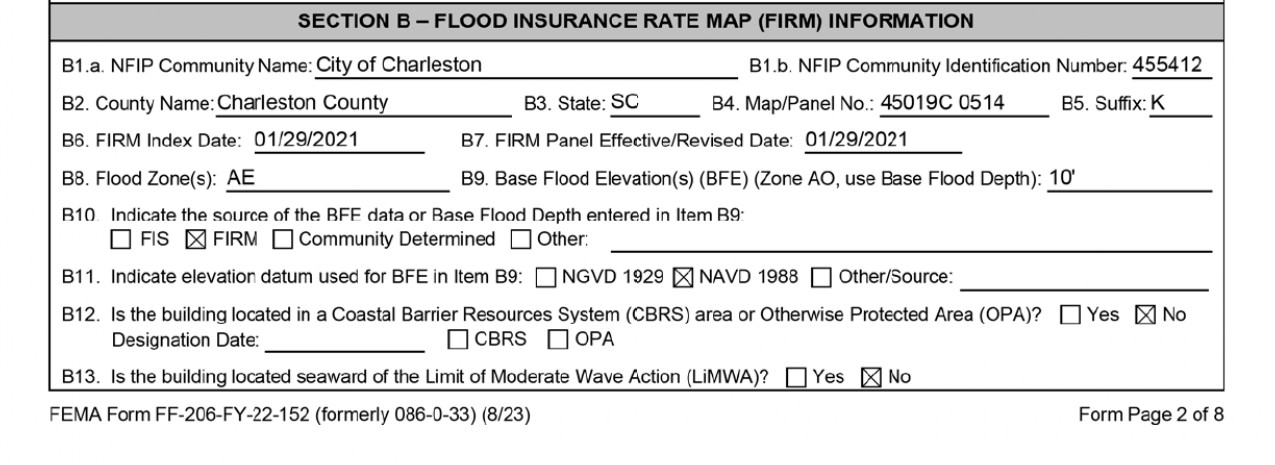
Section B of the form below shows that this property is in an AE flood zone, elevation 10 (see B8 and B9 on the form). This means that the base flood elevation (BFE) is 10 feet above mean sea level (MSL). The required freeboard for the existing building is 1 foot. The DFE (design flood elevation = BFE + 1ft freeboard) for this property is 11 feet.
In an A flood zone, in the City of Charleston, the top of the lowest finished floor of an existing building must be at or above the DFE (11ft for this property).
Section C gives us information about the existing building on this property.
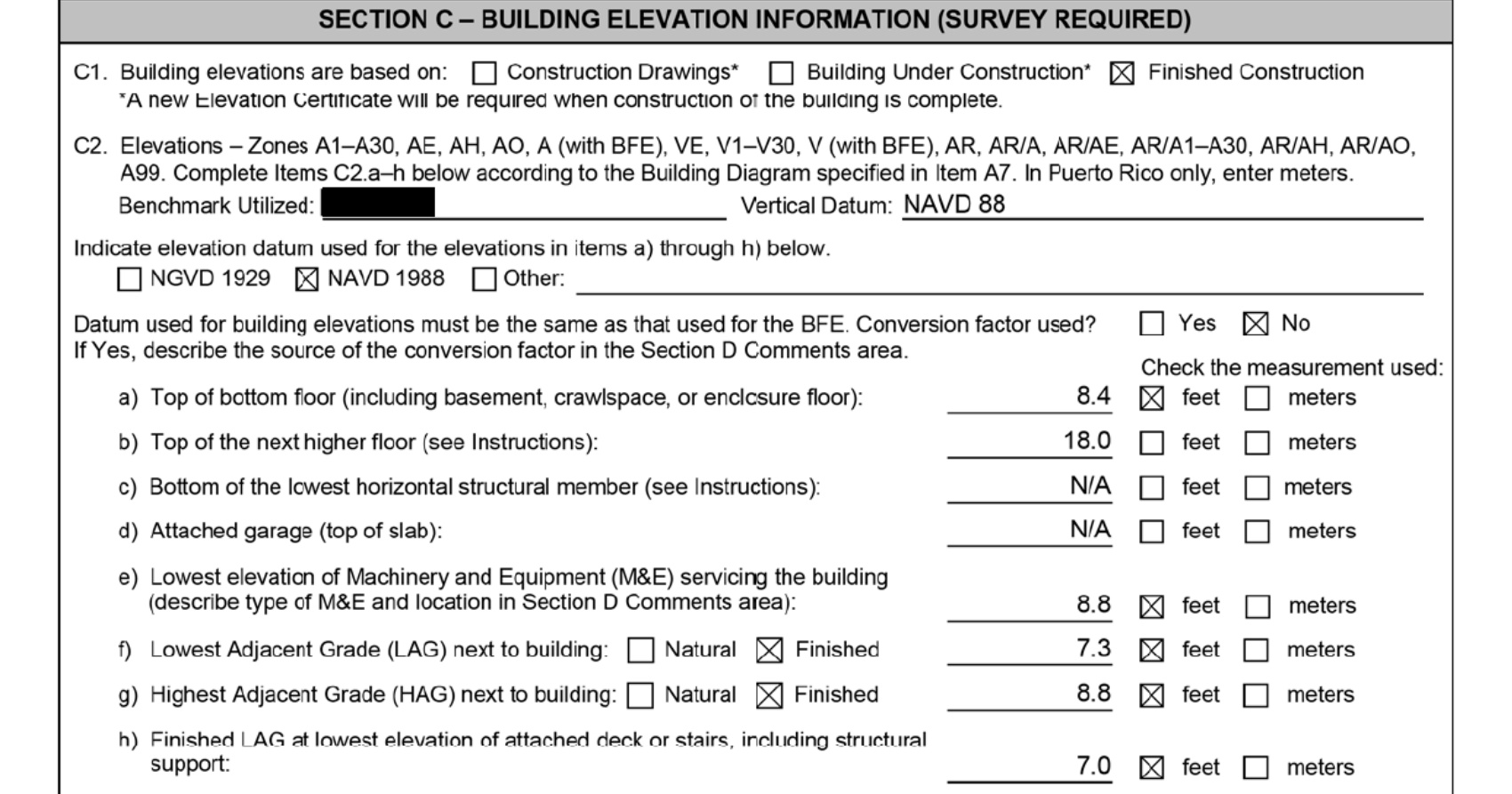
- The top of the lowest finished floor is 8.4 feet MSL. That means the lowest finished floor of the house is 8.4 feet above the midway of the tides. In Charleston, we don’t often get 8 foot high tides; this ground floor is pretty safe, theoretically speaking.
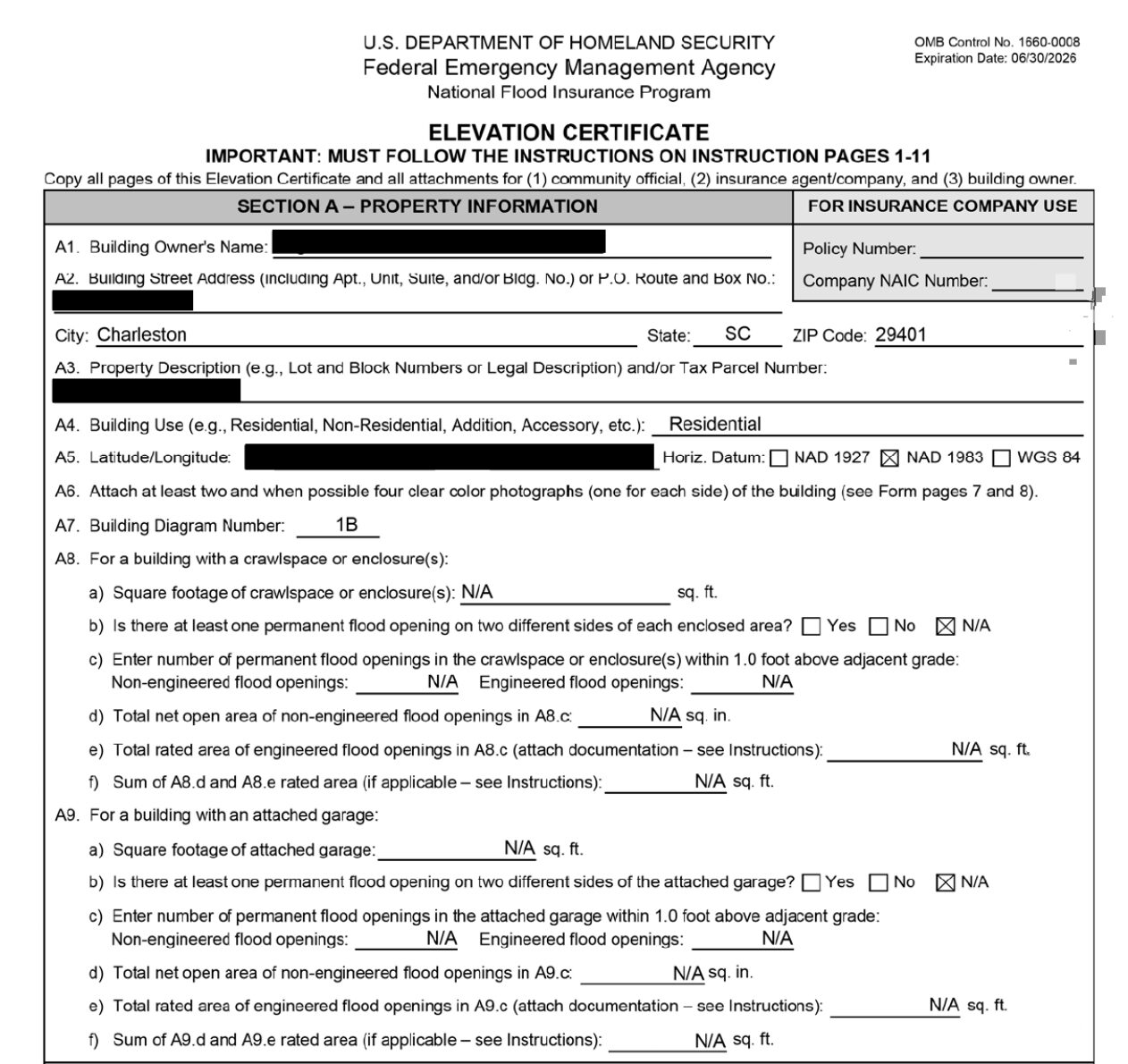
- In Section A, this house is described as Building Diagram Number 1B, meaning it has an elevated slab on grade with no crawlspace.
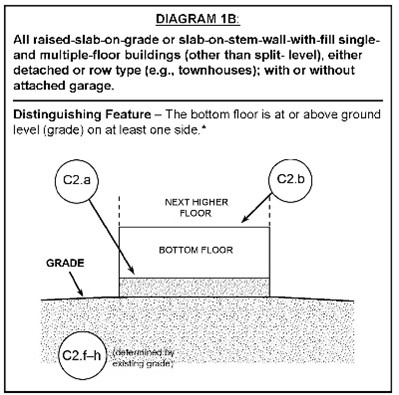
- From a code standpoint, the ground floor is 1.6 feet lower than BFE and 2.6 feet lower than DFE. Per FEMA, spaces below DFE are only to be used for storage or parking cars. This building has living spaces on the ground floor, not meeting current flood codes. The existing living spaces can be grandfathered in, but it will affect the flood insurance premiums.
- The next higher floor of this house (which happens to be the main living floor) is at 18 feet MSL. It’s more than 8 feet higher than the base flood elevation and 7 feet higher than required by code. That’s good news!
What does this mean for a Charleston renovation project (s)?
If the renovation construction cost exceeds 50% of the value of the buildings (appraised value, excluding land), the building must be brought up to current flood codes. This is considered a “substantial improvement” by FEMA.
You can use the tax value for the buildings, as found through the Charleston County tax records, or you can have a private appraisal done. For example, if the value of the buildings (not land) is $500,000, you’ll need to keep your renovation construction costs under $245,000 (~49%) in order to avoid bringing the house up to current codes.
In a case where you have finished spaces below DFE and aren’t required to bring the building up to current flood codes, it’s still a good idea to incorporate flood-resistant construction, such as:
- Use flood-resistant (i.e. waterproof) materials: treated wood or composite trim, tile flooring, water-resistant drywall, etc.
- Locate all electrical outlets and light switches above DFE. In my example, those could be located 3 feet above the floor to be safe.
- Locate HVAC units, ductwork, etc., above DFE, such as putting the ductwork in the ceiling and mounting the condensing units on raised platforms outside above DFE.
- Avoid bathrooms and plumbing below DFE. Imagine a flood situation where the toilet has washed away and all that sewage is allowed to mix into the flood waters…Yuck!
In my sample case, to meet current codes, this house would need to be elevated almost three feet.
There are house movers that can lift a house up, build new foundations and set the house back down at a flood-resistant height. This affects exterior stairs and access, of course. Some houses are more conducive to being elevated than others. The City of Charleston BAR created these guidelines to assist us in the design process.
Alternatively, for this house, the ground floor areas could be abandoned as living areas and used only for storage, since the main living areas are on the second floor above DFE. Not many people want to give up living spaces, though!
Are there ways to avoid bringing an existing house up to current flood codes if the project is a Substantial Improvement (exceeding the 50% mark)?
Yes, but only if the building is historic.
This particular house is historic, built in 1855 and located in the Historic District of Charleston. For this project, restoration and renovation costs will exceed the 50% mark.
The client doesn’t want to give up ground-floor living space, and lifting the house isn’t structurally feasible. Instead, we applied for a FEMA variance, through the City of Charleston Board of Appeals – Building Codes (BOA-BC). This process involves the City of Charleston Board of Architectural Review (BAR) staff sending a letter to South Carolina State Historic Preservation Office (SHPO), asking SHPO to write a letter to the City BOA-BC.
The letter explains that the building is architecturally and culturally significant and should not be required to meet flood codes, such as elevating or lifting the house. This letter and request are presented at the monthly meeting of the BOA-BC, and they typically grant the FEMA variance.
Even if approving the variance, this Board requires that all mechanical, electrical, and plumbing components should be above DFE where possible and/or be constructed to resist flood waters. The Board also warns applicants that insurance premiums may be higher and they are at a greater risk of flood damage by not meeting the flood codes.
Can you expand a house that is noncompliant (below DFE)?
There is no clear answer to this question, unfortunately.
It depends on the flood zone, whether or not the project constitutes a substantial improvement, when the building was constructed, and interpretation of the governing jurisdiction. Before starting any design work, I recommend meeting with the local building department to review your elevation certificate, site survey, and proposed project ideas.
What does this elevation certificate mean for new construction on this property?
There is room to potentially add a garage, pool house, or even another dwelling unit on this site (based on zoning requirements).
Any new construction on this property would have a DFE of 12 feet (BFE 10 + 2ft freeboard). The FEMA elevation certificate tells us that the lowest grade adjacent to the house is 7.3 feet and the highest adjacent grade is 8.8 feet. The ground slopes away from the house, so let’s assume the average ground level is 7 feet. The finished level of the first floor of the living space for a new building needs at least 12 feet MSL, which is 5 feet above grade.
Alternatively, a homeowner may choose to elevate that lowest floor level a bit higher and include a garage or storage below the living space (assuming zoning and design review board standards allow this). In this case, the finished floor might be about 10 feet above ground level, putting it at 17ft MSL, or 5 feet higher than required by code.
Overall, FEMA and NFIP have good intentions born out of past experiences. The flood codes are intended to protect both your life and your property. Sea levels are rising, whether we like it or not.
Natural disasters like hurricanes and storm surge are becoming more frequent and not just affecting beachfront homes. Knowing your risk by understanding an elevation certificate is critical. Use these resources from FEMA and the City of Charleston as you get started.
Then, find the right team to help you envision a safe home that will weather any storm!
How can I help?
If you have a project in the historic district of Charleston, I’d love to help you navigate the design and restoration process. I focus on residential architecture and historic restorations, offering full service to guide you from the very first sketch through move-in day!
Recent Comments